

Built with intention. Growing with heart.

What started as a private practice is becoming something bigger—not because bigger is necessarily better, but because growth makes more possible.
-
A long time ago, when I decided to go back to school to become a counselor, I was fortunate to have mentors and supervisors who invested in me—not only in what I knew, but in the clinician I was becoming.
I remember thinking even then: Someday, I want to do this for someone else.
I wanted to be able to pay forward what had been given to me—to create opportunities for developing clinicians to learn, stretch, discover their own strengths, and have access to the support, experience, challenge, and encouragement that can help them become exceptional clinicians.
For years, I worked in other clinical settings while also building my private practice. Along the way, I had opportunities to supervise and mentor other clinicians, learn from colleagues and different systems of care, work with a wide range of clients, and continue developing my own approach to therapy.
Eventually, when I began asking myself what I wanted the next chapter of my career to look like, I found myself returning to that idea I had carried from the beginning.
CCT could become more than my private practice.
-
Today, we're intentionally growing CCT into a group practice—not because bigger is necessarily better, but because growth allows us to make more possible.
It allows us to reach people I couldn't reach alone. We can broaden the ages, experiences, needs, schedules, communities, and concerns we're able to serve. We can bring together clinicians with different strengths and interests. And we can invest intentionally in clinicians throughout their development, from students and interns to clinicians growing toward independent practice and beyond.
I often tell the clinicians who join CCT:
“You don't work for me. I work for you.”
I take that seriously.
My role isn't to create clinicians who practice exactly like I do. It's to provide opportunities, offer support and challenge, open doors, connect them with expertise beyond my own, and create room for them to develop into thoughtful, competent clinicians with clinical voices of their own.
And as they develop, I keep developing too.
-
One of the greatest gifts of this growth has been something I didn't fully anticipate:
I don't feel like an island anymore.
Private practice can sometimes feel very private. Today, CCT is surrounded by an incredible and growing team.
Some are clinicians. Some are developing clinicians. Others bring expertise in marketing and strategy, business, photography, events, wellness, and areas far outside my own wheelhouse. Some you'll meet on this website. Others work quietly behind the scenes.
All of them make possible things I could never create alone.
I sometimes call us Team Cook, and I'm genuinely in awe every day of what Team Cook is becoming.
I'm especially grateful for the incredible women who have brought their ideas, talents, encouragement, creativity, and expertise to the table as CCT has grown.
This practice is better because they are part of it.
-
We don't believe good therapy means finding one right approach and applying it to everyone.
In fact, one of the things we value most at CCT is calibration.
We pay attention. We get curious. We learn who is in front of us. We notice what is working and what isn't. And we adjust—the amount of structure, support, challenge, pacing, education, reflection, or direction—based on the person and the moment.
We believe the same thing about developing clinicians.
People learn differently. They bring different strengths, experiences, interests, personalities, and places they want to grow. Development shouldn't mean creating clinicians who all look or practice alike.
And we're learning that the same principle applies to CCT itself.
As we grow, we keep asking:
What needs to stay?
What needs to stretch?
What needs to change?
What needs more room?That's why we sometimes call it a celebration of calibration.
Growth doesn't have to mean losing what made something special in the first place. It can mean paying close enough attention to keep adjusting while protecting what matters most.
What Stays At The Center
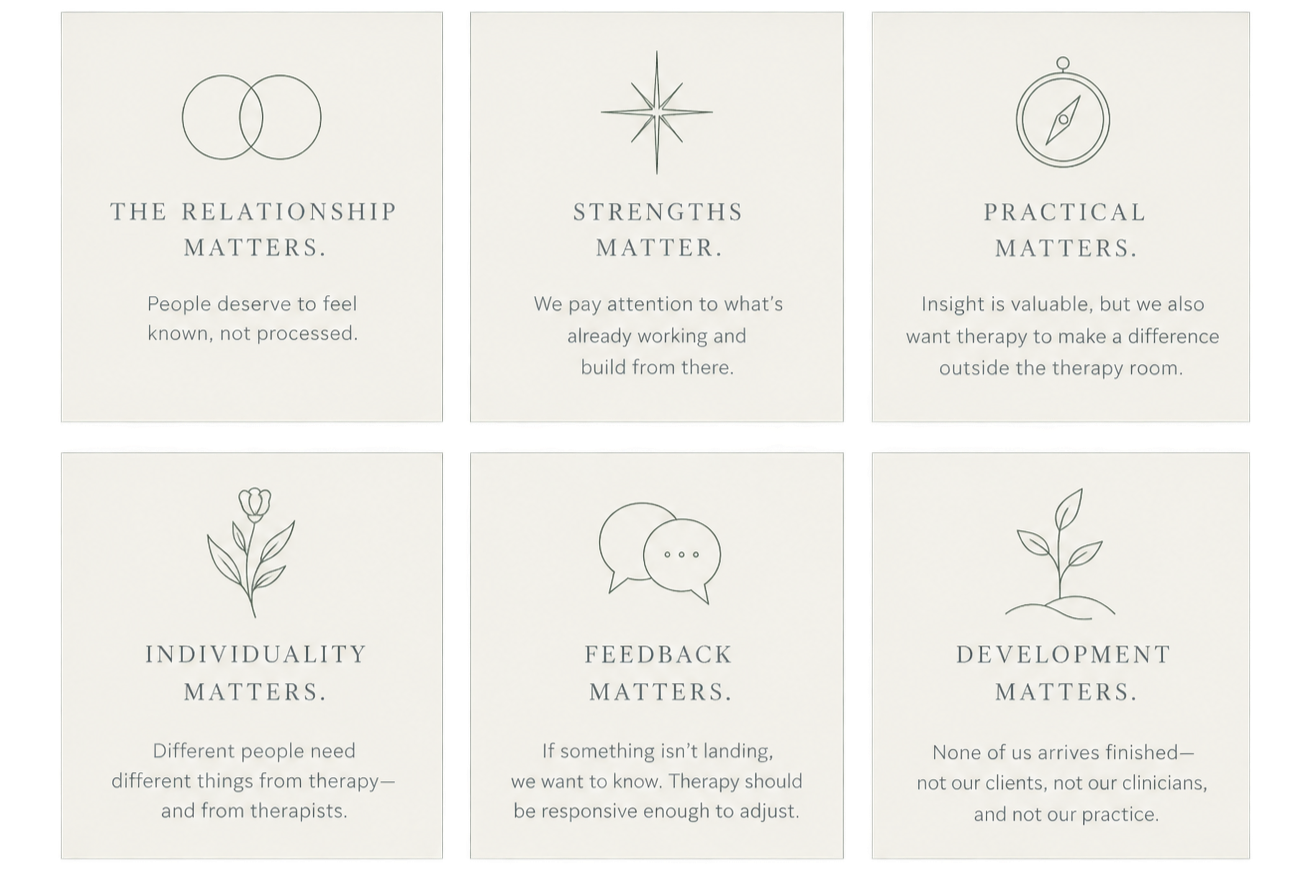
That’s the kind of practice we’re building.